Alysa Liu, freedom, and the difference ownership makes.
Skating on Her Own Terms

That was the first sentence Alysa Liu blurted to the camera right after delivering a near-flawless skate—one that launched her to the top of the podium and ended a 24-year drought for the U.S.
I hadn’t really been following the Games that closely. And if I’m being honest, I’d never even heard of the name Alysa Liu before this or any of the other skaters until recently. Not even the Quad God himself.
But the photos and clips of her performance circulated all over the Internet and the sheer, unfiltered happiness on her face when she won made it impossible not to like her on first glance.
I first became a figure skating fan (or maybe ‘enthusiast’ is the right word?) after stumbling upon Scott Moir & Tessa Virtue’s gold-winning free dance to Moulin Rouge at the 2018 Winter Olympics. The moment the music started playing, I was hooked.
Their chemistry was electric, their transitions effortless, their choreography mesmerising. It didn’t feel like a manufactured or calculated routine, it genuinely felt like a love story unfolding in real time (but sad fact, they’re not together).

I’d be remiss not to mention their facial expressions. His looks of yearning, her dreamy smiles. Safe to say that performance lives rent-free in my head. To this day, I revisit that performance at least once a year. It still gets me. Every. Single. Time.

But Alysa’s performance enamoured me for a different reason. Technically, it wasn’t built around jaw-dropping and meticulously-executed quads like the famous Russian trio prodigies at the 2022 Winter Olympics.
Choreographically, it had its highlights—especially the knee slide into a spin timed perfectly to MacArthur Park—but it didn’t truly mesmerise me in the same way a Yuzuru Hanyu program does—one of the 🐐s in figure skating, period.
What drew me in wasn’t transcendence. It was joy. And that joy makes so much more sense once you know her backstory.
At 13, Liu became the youngest U.S. national champion in history. At 16, she competed at her maiden 2022 Beijing Olympics and finished sixth.
From the outside, it looked like a flawless and meteoric ascent. An unstoppable tour de force. Behind the scenes, however, it was suffocating.
She was made a burnt-out prodigy in a system that decided everything for her: What to eat, what to wear, what music to skate to, when to train. She lived solitarily at the Olympic Training Center. The rink wasn’t just a training ground, it was her entire environment.
The structure that was meant to shape a champion ended up hollowing her and slowly seeping the life out of her. She was miserable, to say the least.
When your identity forms inside that kind of system, it’s easy for achievement to swallow everything else. Winning becomes oxygen. Approval becomes currency. Perfection becomes habit. And slowly, what started as love turns into obligation.
“I didn’t care about competitions. I didn’t care about places. I didn’t care about skaters. I didn’t care about my programs. I just wanted to, like, get away. I wanted nothing to do with that. I hated fame. I hated social media. I didn’t like interviews. Like, I hated all of it.”
Traumatized by the sport, she walked away after her first Olympics and didn’t even want to step near an ice rink again. She truly believed she had hung up her skates for good.
Instead against all odds, she did something radical: She chose life over legacy.
She went to Nepal and trekked to Everest Base Camp. She got her driver’s license. She met new people and opted for psychology at UCLA. She decided her hair should look like a tree, adding rings when necessary. Lived life on her own terms and her conditions only.
“I used to feel like a puppet or a canvas that other people were using. Now I do things for myself.”
When she eventually returned to skating in 2024, it wasn’t to chase medals or redeem a successful comeback narrative. It was purely because she missed it. This time, the terms were truly hers.
She picks her own music.
She decides how she looks—the costumes, the hair, the image she wants to present.
She eats what she wants. No more being starved in the name of “discipline.” No more shrinking herself to meet someone else’s expectations.
The choreography isn’t imposed on her anymore. It’s collaborative. She puts in the elements she actually wants, not just the ones that score well.
“No one is gonna starve me or tell me what I can and can’t eat.”
And that freedom showed. You could see it in her face. In the bright yellow stripes in her hair. In the way she moved through the choreography without hesitation or strain. Just pure, flow state.
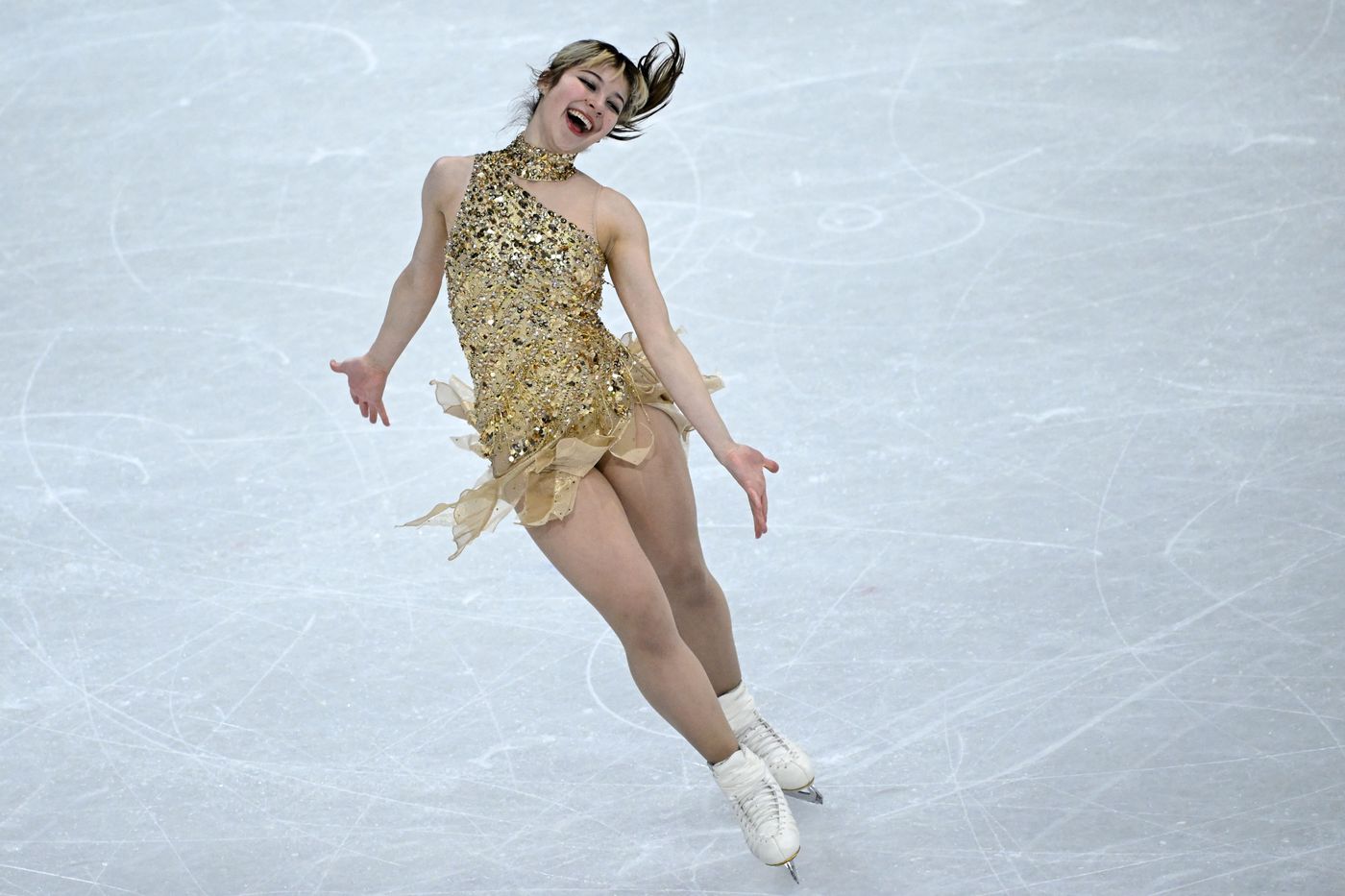
Photo by WANG ZHAO/AFP via Getty Images
The sheer euphoria radiating from her was contagious. Someone on Twitter even said they’ve never seen a skater look more in love with what they were doing at the Olympics. She moved as if joy were the very air she breathed. You see her step away from the rink beaming with joy, smiling ear-to-ear and infecting an entire arena with unshakeable glee. She was joy personified—unburdened, unafraid—and it was intoxicating to watch.
If you haven’t been convinced already at this point, you should definitely watch her performance.
In a world that too often mistakes anxiety for focus and strain for value, her exuberance felt refreshing—almost defiant even. She combined top-level athleticism with true artistic expression, not out of obligation, but because she chose to. It seemed like there were no visible expectations weighing her down.
When she says in an interview she’s skating just to enjoy herself, I actually do believe her.
She wasn’t skating to prove anything. She was skating simply because she loved to. And on the biggest stage in the world, that sense of ownership and self-determination translated into the skate of her life with a beaming smile on her face. Like a sunflower basking fully in the sun.
“The most important part of my story is human connection. My story is more important than anything.”
Photo by The AP’s Christophe Ena
More often than not, we look at performance through the wrong lens and vantage point. We attribute the path to greatness all to control, structure, and sacrifice. We push ourselves and others to grind non-stop, to hustle endlessly and to be disciplined without realising we’re slowly extinguishing out the very spark that makes us human and extraordinary.
To me, Alysa’s journey very much challenged that old-school notion and broke a psychological ceiling.
She didn’t set a new record by performing seven quads. She demonstrated something rarer: That the highest form of human potential might be loving the process itself. That if the pursuit of winning drains the joy from the work, then you’ve already forfeited what mattered most. You’ve lost the plot.
In case you live under a rock, you know that we’re experiencing an A.I. revolution—and the anxiety surrounding it is hard to ignore. People fear replacement because they’ve tied their identity to their output.
If you’re a programmer, Claude Code can produce cleaner code in seconds. If you’re an analyst, it can model scenarios before you finish your coffee. When your worth is measured only by deliverables, speed and optimization, it’s easy to feel like there’s nothing left of you once a machine does it faster.
The ones struggling most are often those who were never connected or resonated to the work itself, but rather only to the rewards attached to it. The title, the recognition, the salary. When creation is reduced to automated output and its materialistic value, the bond between the maker and the craft dissolves. There’s nothing anchoring them to the craft anymore.
The people who will thrive are different. They were never in it only for the outcome. The programmer who loves the puzzle and thrill of solving bugs. The filmmaker who writes because the story won’t leave them alone. The violinist who loses herself somewhere between bow and string. For them, A.I. is just another tool in a practice that was always about something much deeper than the outcome itself.
What Alysa showed the world, medal or not, is this: Separate your worth from your output. The result was never the point. The act of doing—fully, joyfully, on your own terms—that’s the real achievement.
As Brad Stulberg said in his book, The Way of Excellence: The best performers in the world experience deep joy in their crafts. It’s the joy that makes the ferocious dedication, drive and intensity sustainable.
Operating from pure joy, love, and happiness catalyzes creation. It’s one of the few forces in life that multiplies instead of drains It does not push through fear, pressure, or obligation. It pulls through inspiration. When something is rooted in pure joy, the energy behind it is sustainable. It feels alive. It carries lightness and momentum at the same time.
It clears mental clutter. It drowns out comparison, insecurity, and the need to prove oneself. This paves way for creativity to flow more freely. Ideas feel less forced and more like discoveries. We stop manufacturing something artificial just to impress others and start creating to express something authentic and real.
Joymaxxing, as some pundits described her philosophy, is not naïveté, but a mindset. It begs the questions: What risks are worth taking? What kind of presence do I want to embody? What kind of life feels aligned, not merely impressive?

Maslow's Hierarchy of Needs
“The meaning of life is just to be alive. It is so plain and so obvious and so simple. And yet, everybody rushes around in a great panic as if it were necessary to achieve something beyond themselves.” ― Alan Watts
To whoever is reading this, I hope you get to live life doing what you’re most passionate about. I aspire to be the epitome of her in my profession someday, just joymaxxing my way through my career. At the end of the day, you can never outcompete those who are enjoying life.
Alysa Liu did it her way, and proved that it worked. So can you.
So go out there, choose your path, and let yourself glide freely—on your own terms.