The people in that graduation photo knew a version of me I was still performing.
Ten Years On
Last month, while I was doomscrolling on Facebook, I came across a memory my former ustazah had reshared from exactly ten years earlier: a photo of my 5 Diamond class at Kolej DPAH Abdillah, squeezed in front of our classroom noticeboard in maroon graduation robes, just before the ceremony.
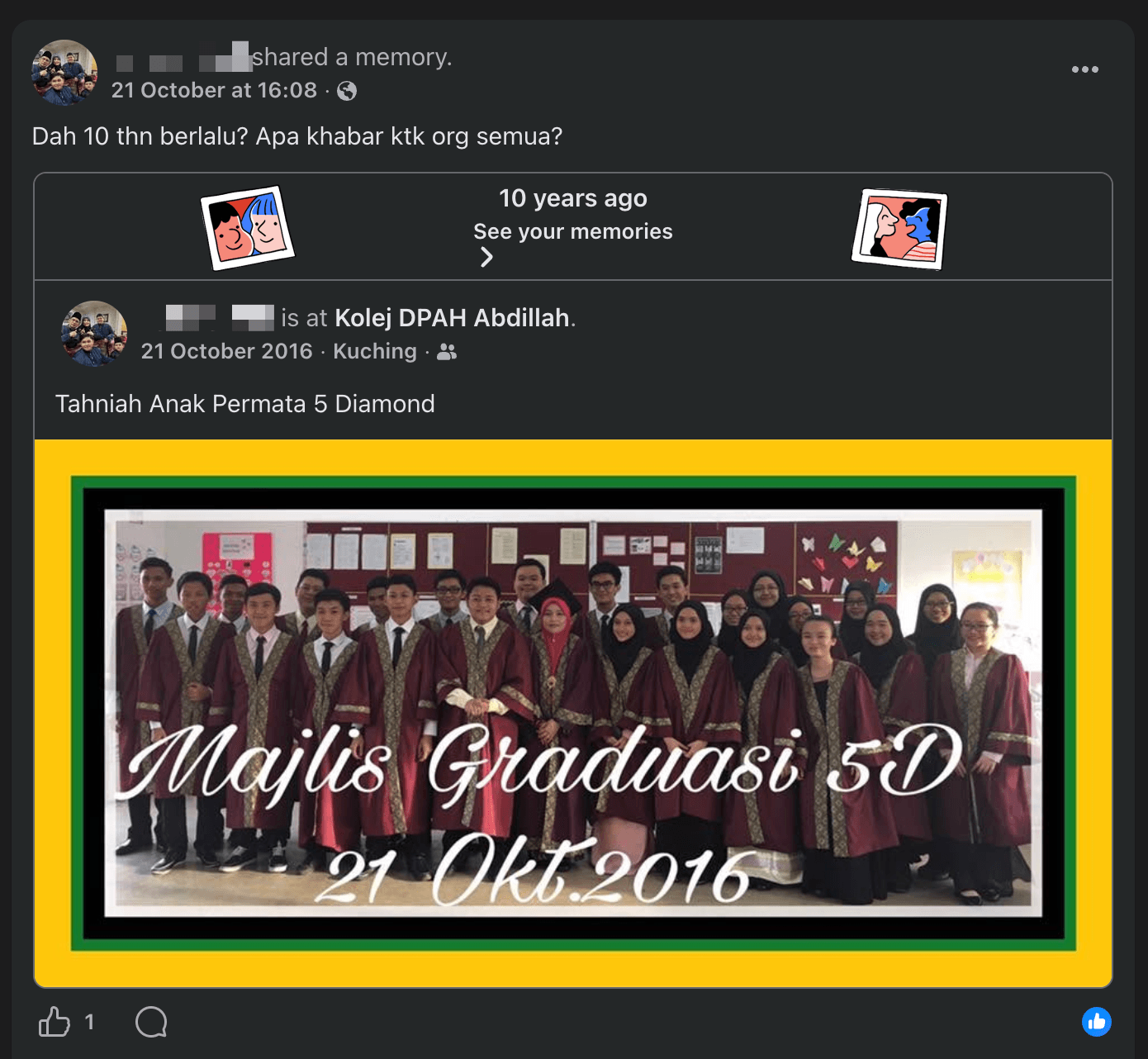
The memory that started it all.
I had to read it twice, because surely it couldn’t have been ten years already. I zoomed in and went through the faces one by one. Most of the names came back instantly, while a few took longer than I’d like to admit (sorry).
And somewhere in there was me at seventeen, just months away from adulthood, looking every bit like the boy everyone expected me to be. Nerdy, by-the-book and more clueless than one might expect.
If you had asked my classmates to describe me back then, I think I already know what they’d say, because I heard some version of it often enough: the calm, put-together one who was good at a bit of everything and rarely put a foot wrong. Some of that was true, but a good chunk of it was a facade I kept wearing because it was easier than correcting everyone.
When I saw her post, it had just one like and no replies. I suspect most of us (including myself) saw it, smiled and kept scrolling.
But her question stuck with me long after I’d put my phone down, and I suppose this is my attempt at answering it.
Devil’s Advocate
I spent most of high school in debate. I started trying out in Form 2, and I did both BM and English (although the latter is far superior, no offence).
It became the headliner of my high school era. I spent so much time preparing for competitions, travelling for tournaments and learning how to construct an argument that I eventually found myself coaching juniors for a year after graduating. Looking back, I probably spent more time debating than I did on some of my actual school subjects.
It also shaped quite a bit of my personality. I became the person who would always have something to say, who’s eager to find a hole in almost any argument, and who would occasionally start a sentence with, “Yes, but…”
I’m sure some of my colleagues today would describe me as someone who has no filter and a vocabulary to match. A far cry from the supposedly quiet and reserved student I was known to be.
Interestingly, some of my schoolmates and seniors used to call me a yes-man. Whenever a teacher asked me to join another competition or take on something extra, I’d agree almost immediately, without stopping to think about what it would cost me or my studies. Not going to lie, the label stung for years, and I think it’s safe to say I’ve since overcorrected.
But looking back, I owe debate a lot. I would’ve been a totally different person had it not been for my involvement in it. There’s something about that environment that fundamentally changed how I think, communicate and carry myself. It’s the reason I could carry myself and hold my own in a room full of equally strong personalities.
What I didn’t realise until much later was what it cost. Debate rewards you for having a rebuttal ready before anyone has said a word, and for turning whatever you’re feeling into something neat and presentable. Years later, my therapist pointed out that I could read every room I walked into except the one inside my own head, which is a polite way of saying that ten years of learning to win arguments still hasn’t helped me win the ones I have with myself.
These days, I’ve learnt to let a lot more things go. Not every opinion I disagree with deserves a rebuttal, and sometimes you just have to pick and choose your battles.
Separate Boxes
One of the things I remember being taught by a senior and coach was to keep the different parts of your life in separate boxes, and only open the one the moment calls for.
At the time, I took that advice rather literally. Colleagues were colleagues, not friends. Work was work, and everything else was everything else. I even came up with a rather confident slogan for myself: “My life starts at 5 PM and ends at 9 AM, every weekday.”
Basically I pulled off a Severance even before it existed and went mainstream. Now, that statement aged like milk.
Somewhere along the way, Teams messages started finding their way into my evenings, and Saturdays were no longer entirely mine. I’ve also caught myself writing this very blog post on a Sunday while simultaneously chatting with a colleague about something work-related. So much for that boundary.
The colleagues-aren’t-friends rule didn’t exactly survive either. Some of the people I work with have become some of the people I genuinely enjoy spending time with outside the office. I suppose it’s difficult to keep people in separate boxes when they inevitably become part of more than one aspect of your life.
I still believe in having boundaries, though. I don’t think everyone needs access to every part of you, and I certainly don’t think being close to someone at work means they need to know everything about your personal life. But there’s a difference between having boundaries and compartmentalising yourself to the point where nobody really knows you.
Plenty of people know me, but hardly anyone knows all of me.
You can’t hand out a different slice of yourself to every room for ten years and then be surprised that nobody has the full picture. And after doing this for long enough, I’m not always sure which parts of myself are genuinely mine and which ones I’ve simply learnt to present because they were more convenient for the situation.
I’m starting to suspect it was a habit for surviving a particular place at a particular age, and I kept running it long after I’d outgrown both.
Leaving Home
Back then, I thought my hometown was everything. I could never have imagined leaving it, convinced that the time and distance away from my family and friends would crush me. Yet moving to KL turned out to be one of the best decisions I’ve ever made, full stop.
I would have been a very different person had I stayed. Even if I’d never known what I was missing, I don’t think I’d particularly like that version of myself. The distance gave me room to figure out who I was without anyone around who had already decided it for me, and I’m not sure that could ever have happened in my comfort zone.
Of course, moving away also meant leaving behind a lot of people. I have lost touch with almost everyone in that photograph, save for a handful. Some friendships simply ran their course, while others faded without either party doing anything particularly wrong. We grew up, found different circles and went on with our lives. I don’t necessarily think we outgrew each other in a bad way; we just grew in different directions.
My former colleague of 2 years who resigned this year was also my ex-high school mate. At some point, he mentioned how different I was from the person he remembered in school. It wasn’t necessarily a compliment or criticism, just an observation. But it made me realise that the people who knew me then and the people who know me now have probably met rather different versions of me.
Drifting away from my high school clique was, in hindsight, one of my first real heartbreaks. At seventeen, I couldn’t imagine a future in which these people wouldn’t be around. I suppose that’s one of the harder things about growing up: you eventually learn that not everyone comes along for the next chapter, even when you desperately want them to.
Anak Permata
Our class was called 5 Diamond, and I remember our teachers and principal occasionally referring to us as anak permata. Other classes, meanwhile, called us dewa, which was probably their way of acknowledging that we were the class of top students. A label I absolutely abhorred, by the way.
There’s something rather amusing about the idea of being a gemstone. A gem is only ever worth what someone else says it’s worth. It gets weighed, graded, held up to the light and appraised for its qualities. And if you think about it, that was pretty much the environment we grew up in.
School was built around appraisals. Exams, rankings, results, SPM grades. You were constantly being measured against a standard, whether it was your classmates, the school’s expectations or your own previous performance. Naturally, you learnt to chase the things that were easiest to measure, often at the expense of everything else.
Sleep, health and friendships became acceptable losses whenever there was another examination around the corner. I don’t think I ever questioned that arrangement. If the grades were good, surely everything else was working out just fine.
I also became rather accustomed to validation. Praise from teachers and good results gave me a sense of reassurance that I was doing something right. On the other hand, even the slightest scolding could send me straight to the school toilet in tears. I was apparently quite good at keeping up appearances, but not particularly good at dealing with the occasional reminder that I wasn’t perfect.
The funny thing is, the appraising never really stopped after school. The report card eventually became a payslip, the class ranking became a job title, and the people holding you up to the light became relatives at open houses, colleagues and acquaintances. Sometimes, the person doing the appraising is yourself.
It took me a while to realise that some of the decisions I’m proudest of today probably wouldn’t have scored very well on the report card I had at seventeen.
Turning down a JPA scholarship and the opportunity to study overseas. Leaving my first job after two years, even when people around me questioned why I would walk away from something that seemed to be working out so well. Learning that logging off at the end of the day doesn’t mean I’m falling behind everyone else.
None of these decisions came with the kind of validation I was accustomed to receiving. In fact, some of them came with quite the opposite. But they were decisions I made because they felt right for me, rather than because they looked good on paper.
Gems are prized for their hardness and permanence, but most of what has gone right for me since that photograph came from being willing to change. If I’m still a permata in any sense, I’d like to think it’s the kind that’s been cut and recut a few times, and is better for it.
The boy in the robe
There’s another photograph from that day that I came across while putting this post together. This time, I’m holding the class valedictorian award, which was given to the student with the best overall achievement in 2016.

I ended up dropping the plaque on stage by the way…
I’ve spent a good part of this post denigrating the boy in that photo. Perhaps that’s a little unfair.
Behind that put-together front was someone who had failed Add Maths multiple times but kept going anyway, and eventually did better than expected in SPM. He also made a few decisions that would lay the groundwork for the person writing this today.
The boy holding that plaque would never have imagined how much was waiting for him beyond that stage: a degree, a career he’d end up building, friends he never expected to make, and the (expensive) hobbies he picked up along the way.
He also wouldn’t have known about the things that wouldn’t go quite as planned. The difficult year after school that I still don’t talk about much. The burnout. Walking away from my first job when things seemed to be going so well. Losing people I once thought would always be around.
If you had shown him all of it back then, I doubt he’d have believed you. He’d probably have assumed that plaque was the peak, and that everything after would just be about living up to it. I’m glad he got that wrong, even if it took me the better part of ten years to see it.
If I could go back, I don’t think I’d tell him much, apart from maybe bracing him for the couple of years after school. Even then, I doubt he’d have listened. Most of what I know now, I only know because I got it wrong first: the arguments I should have let go of, the boxes I kept shut for far too long, and the years spent chasing whatever looked good on paper. I’m not sure I’d want to take any of that away from him.
Looking back, I don’t think the boy in that photograph was particularly wrong about what mattered to him. The things he worried about were real to him at the time, just as the things keeping me up at night today feel real to me now.
Ten years from now, I’ll probably sit down and write another one of these. If history is anything to go by, I’ll cringe at half of what I wrote here, have a fresh set of opinions to defend, and wonder how any of this ever felt like such a big deal.
I’m curious to find out which half.